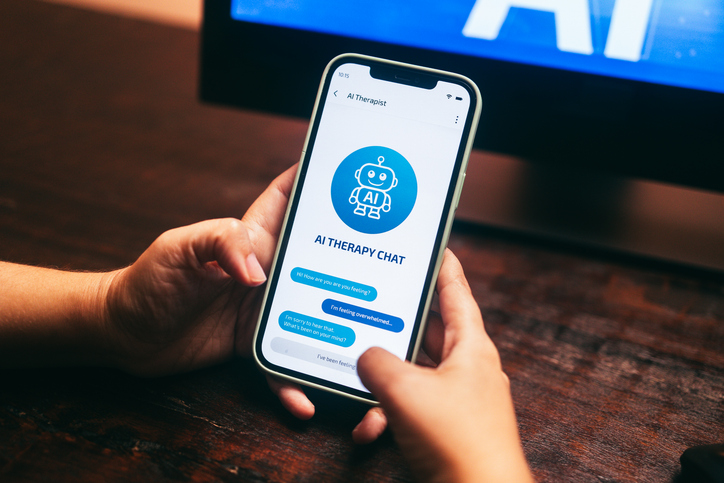
I’ve sat through a few conversations this year involving AI and mental health. I can tell you that some of those conversations have been genuinely thought-provoking. Others have left me with a familiar uncomfortable feeling, like the one you get when something is being sold harder than the evidence warrants.
I want to be clear about where I’m coming from. I’m not a technophobe, and I’m not opposed to new ways of working. But I’ve spent enough years in this sector to know that when something promises to transform mental health services while cutting costs, the people who tend to benefit least are the ones we’re supposed to be serving. So here’s my honest take.
There’s a real case for AI in mental health
The mismatch between how many people are in dire need of mental health support and how many clinicians exist to provide it is a massive problem. It’s worsening and it’s costing lives. So, in that context, dismissing this kind of technology off the bat isn’t the right thing to do.
What I find especially interesting is the potential for early intervention, like help in spotting signs of deterioration weeks before a crisis, rather than responding after the fact. I’m also interested in what better tech could do for our own staff. Our support workers spend a significant chunk of their working day on documentation, referrals, and admin. All time spent on paperwork is time not spent with the person on their caseload. If the right tools could shift that balance, I’d take that seriously.
There’s also the simple reality of out-of-hours. We work with people who have long-term, complex mental health needs. For many of them, the difficult moments don’t happen at the convenient time schedule of nine to five. Something that could offer a point of contact at two in the morning, that could hold the line until a person can speak to someone human, now that’s a worthy contribution.
But I’ve seen what goes wrong too
Earlier this year, the Guardian reported that Google’s AI Overviews (reaching around two billion users a month) were producing inaccurate and, in fact, dangerous responses to questions about conditions such as psychosis and eating disorders. Mind called some of the outputs “dangerously incorrect” and has now launched what it describes as the first global inquiry of its kind into mental health and artificial intelligence. That’s a concern, and that’s happening at scale right now.
Beyond bad information, there are other documented problems. Chatbots in supported housing settings have been found to respond to paranoid and delusional beliefs in affirming, encouraging tones, clearly the complete opposite of what someone in that situation needs. There are real questions about where private mental health information ends up and who profits from it. Plus, there’s the well-evidenced problem of bias with this technology. AI is built on sets of data that don’t represent the diversity of people seeking help and will systematically fail those who are already most likely to fall through the cracks.
But the risk I think the sector is least willing to name directly is the worry that AI starts to become the cover story for cutting human contact. Not because outcome data supports it but because the numbers look better on a spreadsheet.
The question worth asking
Whenever a mental health service is considering deploying AI, I think the honest question to ask is “Who does this actually serve?”
If the answer is that it gives skilled workers more time with the people on their caseloads or reaches people who’d otherwise get nothing, that’s a use of technology worth pursuing.
If the answer is that it lets an organisation justify reducing staffing levels, for example, or shortening the time a person spends with someone who knows them… then I think that needs saying plainly, and it needs to be pushed back on. The evidence on what makes mental health support work is consistent and unambiguous. It’s the relationship and the continuity. It’s the worker who’s been there long enough to notice when something has changed with their client.
At Bridge Support, that’s what we build around every day because it’s what we see working day after day with some of the most complex caseloads in the country.
What responsible use looks like
If AI is going to do genuine good in mental health settings, a few things are non-negotiable. It needs to:
- Sit alongside human care, not substitute for it. Any deployment being used to justify cuts to staffing or direct contact time should face serious challenges.
- Be safe. Recognising crisis, providing accurate information, pointing clearly to professional help. That’s the floor, not a bonus feature.
- Be honest about what it is. People interacting with these AI tools should know they’re not talking to a professional. The confident, authoritative tone these systems often adopt, the kind that can make a poorly-sourced summary sound like a clinical opinion is a genuine risk. Calling it a feature doesn’t make it one.
People with lived experience need to be in the room when these tools are designed, not consulted afterwards. The people most likely to be hurt by poor AI in this space are those already in the most precarious positions. Their input should shape how these systems are built and how they’re held to account.
The pressure on mental health services is real, and I’m not dismissing it. But the answer to a workforce crisis is not a product that simulates the workforce.
The question is never really whether AI has a role. Used well, it absolutely does. The question is whether the people making decisions about it are being honest enough about what “used well” actually requires.
For us, that’s the standard we hold ourselves to. I’d encourage the rest of the sector to do the same.
Further Reading
Meeting NHS DSP Toolkit and CE+ Standards in the Age of AI
How Can Charities Lead Change Without Breaking the System?
The Role of Third Sector Organisations in Integrated Care Systems